The Strategy Playbook Hits Privacy
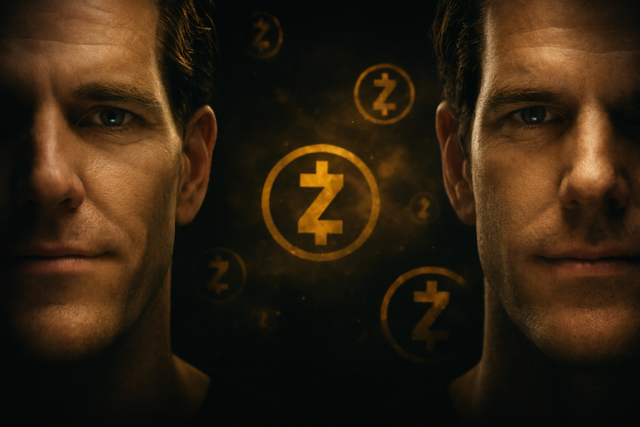
This institutional play isn’t just about price. It’s about controlling privacy infrastructure.
📊 Data Verified: 18:56 UK Dec 9, 2025 | ZEC: CoinGecko/CoinMarketCap | Cypherpunk: SEC filings/PR Newswire | ETF: Grayscale S-3 filing | SEC Roundtable: SEC.gov Dec 5
At a Glance
| Metric | Reading | Signal |
|---|---|---|
| Zcash Price | $415-445 | 🟢 +2,664% from July ATL ($16.08) |
| Cypherpunk Holdings | 233,644 ZEC (1.43% supply) | 🟢 $68M deployed, 5% target |
| Shielded Adoption | 30%+ of supply | 🟢 Record highs |
| Key Catalyst | SEC Privacy Roundtable Dec 15 | 🟡 Zooko presenting |
Scenario Update:
- Scenario A (Privacy Integration): 55% ← regulatory clarity accelerating
- Scenario B (Regulatory Limbo): 35% ← mixed signals persist
- Scenario C (Regulatory Exile): 10% ← declining on institutional engagement
Read paths: 2 min (this box) | 5 min (bold sections + blockquotes) | 12 min (full brief)
If you only take three things away:
- Winklevoss/Cypherpunk are running a Strategy-style playbook on ZEC (5% supply target via NASDAQ equity).
- Grayscale, BPCE, EF/Railgun, and the SEC roundtable show privacy is being integrated, not banned.
- The thesis is about structural repricing of privacy, not chasing a 26x move; timing and regulation remain the core risks.
What’s Happening Now
Privacy coins were supposed to be dead.
The consensus was clear: exchange delistings, EU MiCA restrictions on the horizon, Tornado Cash prosecutions setting precedent. The sector was radioactive. Untouchable. No institutional future.
Then the Winklevoss twins launched a NASDAQ-listed company to accumulate 5% of Zcash’s supply.
This brief examines what consensus missed. We’ll trace the institutional signal chain, stress-test the Strategy playbook comparison, and provide a framework for evaluating whether privacy is being repriced from regulatory pariah to infrastructure layer.
Educational Intent: This analysis synthesizes public filings, market data, and institutional positioning to help readers develop pattern recognition for sector repricing events. This is not financial advice.
The Noise: “Privacy Coins Are Dead”
If you’ve followed crypto discourse over the past three years, the narrative on privacy coins was settled: they were uninvestable.
The evidence seemed overwhelming. Binance delisted Monero across multiple jurisdictions. Coinbase restricted privacy features. The EU’s Markets in Crypto-Assets regulation threatened to ban anonymous transactions entirely by 2027. When Tornado Cash developers were prosecuted, the message seemed clear: building privacy infrastructure was a path to prison, not profit.
ZEC traded at $16.08 in July 2024. While Bitcoin approached $100,000 and Ethereum consolidated above $3,000, the largest privacy-focused cryptocurrency by market cap lingered at levels unseen since its earliest days. Retail had abandoned the sector. Institutions, it was assumed, wouldn’t touch it.
This was the consensus three months ago.
The Debunk: The data tells a different story
Here’s what actually happened while the narrative declared privacy dead.
ZEC rallied 2,664% from its July low. The token moved from $16 to above $700 at its November peak, briefly becoming one of the year’s best-performing major assets. Even after recent pullback to the $400-445 range, it remains up more than 2,400% from summer lows.
The sector outperformed everything. Artemis data shows privacy-focused tokens climbed more than 237% in 2025, outpacing both Bitcoin and Ethereum. The “dead” sector became the year’s alpha generator.
Shielded adoption hit record levels. Over 30% of ZEC supply now sits in encrypted shielded addresses, up from roughly 10% in 2024. More than 30% of transactions touch the shielded pool. This isn’t speculative froth; it’s functional adoption of privacy infrastructure.
The data contradicts the narrative. But data alone doesn’t explain why. For that, we need to trace what institutions were actually doing.
The Pivot: The Cypherpunk Thesis
On November 7, 2025, a former biotech company called Leap Therapeutics announced it was pivoting to become Cypherpunk Technologies, a digital asset treasury company focused exclusively on Zcash. The name wasn’t accidental. The Winklevoss twins’ investment firm led a $58.88 million private placement.
This is the Strategy playbook applied to privacy.
The parallels are instructive:
When Strategy (then MicroStrategy) began accumulating Bitcoin in 2020, the asset was still considered too volatile for corporate treasuries. Saylor’s thesis was simple: Bitcoin offered asymmetric upside as a treasury reserve asset, and early accumulation by a public company would create a premium to net asset value.
Cypherpunk is running the same play, but targeting what they view as a more fundamental primitive: privacy.
The position as of December 9, 2025:
| Metric | Cypherpunk (ZEC) | Strategy (BTC) Early Stage |
|---|---|---|
| Total Holdings | 233,644 ZEC | ~70K BTC (2020-21) |
| % of Supply | 1.43% circulating | ~0.35% circulating |
| Capital Deployed | $68M | ~$2.2B |
| Average Cost Basis | $291.04 | ~$24,000 |
| Target | 5% of total supply | Continuous accumulation |
The comparison isn’t perfect. Strategy operates at vastly larger scale today, with 660,624 BTC worth roughly $60 billion. But the structural similarity in approach is notable: use public equity markets to accumulate a scarce digital asset, targeting a meaningful percentage of supply.
Current paper gains: At $415-445 per ZEC, Cypherpunk’s $68 million position is worth approximately $97-104 million, representing roughly 43-53% unrealized profit on a cost basis of $291.
Bottom line: Cypherpunk isn’t speculating on price. They’re executing a documented treasury strategy with specific supply targets, backed by principals who built a crypto exchange from zero to $60+ billion in custody.
The Institutional Signal Synthesis
Cypherpunk isn’t operating in isolation. The past three months have produced a cascade of institutional positioning that consensus largely ignored.
The Winklevoss Architecture:
Today, December 9, Cypherpunk announced that Zooko Wilcox has joined as Strategic Advisor. Zooko founded Zcash, served as CEO of the Electric Coin Company for years, and currently serves as Chief Product Officer at Shielded Labs. Will McEvoy, a principal at Winklevoss Capital, serves as Cypherpunk’s Chief Investment Officer and sits on the board.
The Winklevoss twins are building a vertically integrated privacy play: capital deployment through Cypherpunk, protocol expertise through Zooko. This isn’t a trade; it’s infrastructure development.
Grayscale’s ETF Filing:
On November 26, Grayscale filed an S-3 registration statement to convert its existing Zcash Trust (ZCSH) into a spot ETF. If approved, this would be the first privacy-coin ETF available to US investors. The trust currently holds approximately 2.4% of ZEC’s circulating supply and manages roughly $196 million in assets.
Craig Salm, Grayscale’s Chief Legal Officer, noted that the December 15 SEC roundtable represents an opportunity for the industry to demonstrate that privacy protocols can coexist with regulatory goals. Grayscale isn’t filing this speculatively; they’re positioning for regulatory clarity they expect to achieve.
The French Banking System:
Groupe BPCE, France’s second-largest banking group, reportedly rolled out ZEC access to customers through its crypto subsidiary. European banks appear to be moving before their regulators have finalized restrictions.
The Endorsement Chain:
- Naval Ravikant described ZEC as “insurance against Bitcoin” in an October post that triggered a 60% single-day price surge
- Arthur Hayes published a $10,000 price target, triggering a 30% intraday spike
- VanEck’s CEO flagged Zcash as a plausible Bitcoin alternative for privacy-conscious investors
These aren’t random retail influencers. When capital allocators of this caliber start publicly positioning, the signal usually leads the price.
What the noise concealed: While retail debated whether privacy coins were uninvestable, a coordinated institutional positioning was already underway. Cypherpunk’s treasury accumulation, Grayscale’s ETF filing, and endorsements from sophisticated allocators weren’t coincidental. They represent different nodes in the same thesis: privacy infrastructure is being repriced.
The SEC Roundtable: Why December 15 matters
The SEC’s Crypto Task Force will host a roundtable on Financial Surveillance and Privacy on December 15 at its Washington, D.C. headquarters. This isn’t a routine regulatory meeting.
Commissioner Hester Peirce, who leads the task force, framed the event as an opportunity to “recalibrate financial surveillance measures to ensure the protection of our nation and the liberties that make America unique.”
The panelists read like a blueprint for privacy integration:
Panel 1 features Zooko Wilcox alongside representatives from Espresso Systems, Aleo Network Foundation, Digital Asset, Predicate, and SpruceID. These are teams building zero-knowledge proofs, identity systems, and private computation frameworks.
Panel 2 includes StarkWare, Penumbra Strategies, the Blockchain Association, and the ACLU. Policy, advocacy, and civil liberties.
This is not an adversarial hearing. It’s a structured dialogue between regulators and privacy builders, occurring after privacy tokens have already demonstrated massive market demand. The timing is deliberate.
Framework for Interpreting Outcomes:
- Constructive engagement (regulatory pathway emerges) → Accelerates institutional adoption, validates Grayscale ETF thesis
- Neutral acknowledgment (no clear direction) → Status quo persists, uncertainty premium remains
- Hostile framing (privacy = illicit activity) → Regulatory risk materializes, delisting pressure intensifies
The roundtable follows the Tornado Cash sanctions being lifted in March 2025 after a federal appeals court ruled OFAC had overstepped. The regulatory environment is shifting, not hardening.
The Valuation Framework: Stress testing the bull case
Tyler Winklevoss has stated the thesis explicitly: ZEC could achieve “a meaningful percentage of Bitcoin’s market cap.” What does that actually imply?
Current State:
- ZEC market cap: ~$7.3 billion
- BTC market cap: ~$1.9 trillion
- ZEC as % of BTC: ~0.38%
Scenario Analysis:
| ZEC as % of BTC | Implied ZEC Market Cap | Implied Price per ZEC |
|---|---|---|
| 1% | $19B | ~$1,160 |
| 2% | $38B | ~$2,320 |
| 5% | $95B | ~$5,800 |
| 10% | $190B | ~$11,600 |
These numbers seem aggressive until you consider framing. ZEC at 1% of Bitcoin’s market cap would represent roughly $1,160 per token, a 2.6x from current levels but still 64% below its 2016 launch-day high of $3,191.
The bull case isn’t that ZEC becomes Bitcoin. It’s that privacy infrastructure achieves some modest fraction of store-of-value allocation in a world where financial surveillance is accelerating globally.
A note on timing:
Nothing in this brief says current prices are “cheap.” ZEC has already moved 26x from its July low. The thesis is about where structural capital is positioning, not whether $415 is a good entry.
Institutional playbooks run in years. Retail PnL runs in months and days. ZEC can halve from here and the Cypherpunk thesis can still be intact. The repricing story and entry timing are separate questions, and this brief only addresses the first.
Where This Thesis Can Be Totally Wrong:
- Regulatory rug: EU MiCA implementation (2027) could mandate privacy coin delistings across European exchanges. The SEC roundtable could turn hostile rather than constructive. FinCEN’s Section 311 proposal on crypto mixing remains unfinalized; a harsh final rule would materially damage the sector.
- Fragmented adoption: Monero retains a committed user base and stronger privacy guarantees (mandatory vs. optional shielding). ETH-native solutions like Railgun could capture the privacy premium without ZEC. The institutional bet has gravitated toward ZEC partly due to regulatory optics (hybrid model, US-based ECC, academic pedigree), but that’s a bet on regulatory perception, not technical superiority.
- Cypherpunk execution risk: They could be the Block.one of ZEC rather than the Strategy of privacy. Raising capital and buying tokens is the easy part; building sustainable premium to NAV requires years of execution. The Strategy comparison is structural, not a guarantee of outcomes.
- Hybrid model satisfies nobody: ZEC’s transparent/shielded optionality may prove to be a weakness. Privacy maximalists prefer Monero’s mandatory shielding. Regulators may ultimately treat any shielded capability as equivalent to full privacy. The middle ground could collapse from both sides.
Educational observation: Valuation frameworks should be treated as thought exercises, not predictions. The purpose is to understand what different outcomes imply, not to suggest certainty about any scenario.
Part II: The Ethereum Beta. Railgun as the Privacy Rail
If ZEC is the native chain bet on privacy, Railgun is the middleware bet that plugs privacy into Ethereum itself. They’re not competing theses; they reflect different expressions of the same repricing: base-layer privacy versus EVM privacy rails.
For readers seeking privacy exposure through Ethereum’s ecosystem rather than an independent chain, Railgun (RAIL) presents a different structural play.
What Railgun Does:
Railgun is a smart contract system providing zk-SNARK privacy for any transaction or dApp interaction on Ethereum, Arbitrum, Polygon, and BSC. It enables users to trade, lend, and interact with DeFi protocols privately without leaving their shielded address.
The Ethereum Foundation Connection:
Vitalik Buterin has used Railgun repeatedly in 2025, most recently transferring $2.9 million in ETH through the protocol in November. He’s publicly praised Railgun’s “Private Proofs of Innocence” system, which allows users to prove their funds don’t originate from sanctioned sources without revealing transaction details.
The Ethereum Foundation is developing Kohaku, an SDK for integrating privacy into EVM wallets, with native Railgun support. Partners include MetaMask and OKX Wallet. This isn’t peripheral; it’s core infrastructure development.
The Comparative Positioning:
| Metric | Zcash (ZEC) | Railgun (RAIL) |
|---|---|---|
| Market Cap | ~$7.3B | ~$145-180M |
| TVL | N/A (native chain) | ~$113M |
| Annual Protocol Revenue | N/A | ~$5M (0.25% fee on flows) |
| Institutional Backing | Cypherpunk, Grayscale | EF, DCG ($7M raise) |
| Key Differentiator | Native privacy chain | Privacy layer on Ethereum |
Railgun’s market cap is roughly 2% of Zcash’s. If the privacy thesis plays out, both should benefit, but RAIL offers higher beta with different risk characteristics (smart contract risk, smaller anonymity set, regulatory classification as DeFi infrastructure vs. privacy coin).
You don’t have to choose ZEC or RAIL; they reflect different parts of the same repricing. The question is whether you want exposure to privacy as a standalone asset (ZEC) or privacy as infrastructure embedded in the dominant smart contract platform (RAIL).
Observable Patterns: What to watch
Cypherpunk Accumulation Pace:
The company has deployed $68 million toward a 5% supply target. At current prices ($415-445), reaching 5% (1.05M ZEC) would require approximately $370-420 million in additional purchases. Watch their SEC filings for acquisition announcements and pace of deployment.
Shielded Adoption Curve:
The move from 10% to 30%+ shielded supply in 2024-25 represents functional adoption, not speculation. Continued growth would validate the thesis that users actually want privacy, not just price exposure.
Grayscale ETF Timeline:
Historical pattern suggests Q1 2026 decision. Watch for SEC acknowledgment letters and extension notices.
Railgun TVL Growth:
TVL near all-time highs (~$113M) despite token price volatility suggests sticky usage. Acceleration would indicate growing demand for Ethereum-native privacy infrastructure.
SEC Roundtable Outcomes:
The December 15 event will not produce binding rules, but regulatory tone matters. Constructive dialogue versus adversarial positioning will shape institutional comfort with privacy positioning.
The Signal: What this means
Privacy is being repriced from regulatory pariah to infrastructure layer.
The catalyst isn’t ideology; it’s structural demand. AI surveillance capabilities are accelerating. Financial surveillance requirements are expanding globally. The same institutions that once assumed privacy was uninvestable now see it as essential infrastructure for functioning markets.
The Cypherpunk thesis isn’t that privacy coins go to the moon. It’s that some baseline level of financial privacy is a necessary feature of a functional digital economy, and the assets providing that privacy will capture value accordingly.
The playbook is Strategy’s:
Use public market infrastructure to accumulate a scarce asset with structural demand tailwinds. Target a meaningful percentage of supply. Align protocol development expertise with capital deployment. Wait for regulatory clarity to unlock institutional access.
Whether Cypherpunk achieves Strategy-level returns depends on factors outside anyone’s control: regulatory outcomes, competitive dynamics, and market cycles. But the structural positioning is coherent, the capital is deployed, and the institutional signal chain is documented.
One story trended. The other will matter.
Week Ahead: Catalysts and Framework
December 15 (Monday):
- SEC Crypto Task Force Roundtable on Financial Surveillance and Privacy
- 1:00 PM - 5:00 PM ET, SEC headquarters, Washington, D.C.
- Live webcast on SEC.gov
Ongoing:
- Cypherpunk accumulation (watch for 8-K filings)
- Grayscale ZCSH ETF review process
- Railgun Kohaku development (EF timeline)
Framework for December 15:
The roundtable outcome shapes near-term positioning. Constructive engagement validates the integration thesis and likely accelerates institutional entry. Neutral outcomes extend the current uncertainty premium. Hostile framing would represent a material setback for the sector.
The market is pricing some probability of positive outcomes; the question is whether that probability is correct.
Key Levels and Close
ZEC Technical Context:
- Current: $415-445
- Support cluster: $300-340 (prior breakout zone)
- ATH: $3,191.93 (Oct 29, 2016)
- From ATL: +2,400-2,600%
Cypherpunk Positioning:
- 233,644 ZEC accumulated
- $291 average cost basis
- 5% supply target = 1.05M ZEC
- ~$370-420M additional capital needed at current prices
The Winklevoss twins didn’t launch a NASDAQ company to make a trade. They built infrastructure for a thesis that requires years to play out. The institutional positioning documented in this brief represents the early innings of that deployment.
Privacy isn’t being repriced because the technology changed. It’s being repriced because the world changed, and patient capital noticed before consensus did.
Sources: CoinGecko | CoinMarketCap | SEC.gov | Grayscale (S-3 filing) | PR Newswire (Cypherpunk announcements) | CoinDesk | The Block | DefiLlama | BeInCrypto
Disclaimer: This brief is for educational purposes only. It does not constitute financial, investment, or legal advice. The author holds no position in any asset mentioned. Always conduct your own research and consult qualified professionals before making investment decisions.
Pierce & Pierce: Democratising Institutional Grade Intelligence